
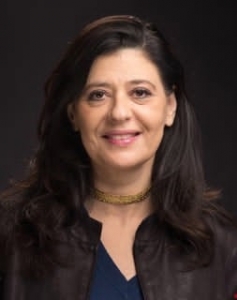
Kaouther Ben Hania will return to Venice next September in a role that marks an important new step in her career. The Tunisian director and screenwriter will serve on the International Jury of the official competition at the 83rd Venice Film Festival, which will run from Sept. 2 to 12, 2026.
Chaired by Maggie Gyllenhaal, the jury will also include Johnnie To, Xavier Giannoli, Shahrbanoo Sadat, Daniel Blumberg and Francesco Casetti. Together, they will be responsible for awarding the Golden Lion, the festival’s top prize, as well as the other official awards in competition.
The announcement carried a deeply personal resonance in the message Ben Hania shared on Facebook. After expressing her joy and honor at joining the international jury, the filmmaker reflected on what Venice has meant in her own journey:
“Venice is a festival that has deeply marked my life. I return almost every year, always with the same emotion. Last year, I experienced an unforgettable moment there with The Voice of Hind Rajab… and this year, I am coming back as a member of the jury. Thank you for the trust.”
That message immediately sets the tone. Ben Hania speaks of Venice with an emotion that goes beyond professional recognition. She evokes a festival that has accompanied several decisive moments in her career, from the early stages of some of her films to her most recent international acclaim.
The First Arab Woman Filmmaker on the International Jury
The historic weight of this appointment deserves to be stated clearly. Kaouther Ben Hania becomes the first Arab woman filmmaker invited to sit on the International Jury of the official competition at the Venice Film Festival. The distinction matters, because in Venice each jury corresponds to a specific section, prize and responsibility.
Arab presence on this jury has remained exceptional. Among filmmakers, the names are limited to a handful of major male figures: Youssef Chahine, Mohammed Lakhdar-Hamina, Elia Suleiman and Abderrahmane Sissako. With Ben Hania, a new page opens. For the first time, an Arab woman filmmaker joins the circle responsible for choosing the films that will shape Venice’s official prize list.
Other Arab women have previously been invited to serve on juries across different Venice competitions, sections or awards, including Dora Bouchoucha, Hend Sabry, Sofia Djama, Soudade Kaadan and Erige Sehiri. Their presence also matters in the relationship between Arab cinema and Venice. But Ben Hania’s appointment occupies a particular place: she is the first Arab woman filmmaker to join the International Jury of the official competition, the jury that awards the Golden Lion, the highest prize at the Venice Film Festival.
An International Career That Has Become Impossible to Ignore
Ben Hania’s selection feels almost inevitable. Over the past several years, the Tunisian filmmaker has reached a rare level of international recognition. Three films directed by her have been nominated for Oscars: The Man Who Sold His Skin, Four Daughters and The Voice of Hind Rajab. Added to that are nominations at the Golden Globes, the BAFTAs and several major international awards events.
In 2021, Kaouther Ben Hania was also invited to join the Academy in the directors and writers branches.
Such a trajectory remains exceptional for an Arab filmmaker. It is also remarkable for a woman director, regardless of nationality. Ben Hania has built a body of work that travels through the world’s major festivals, reaches the biggest awards ceremonies, sparks debate, stirs emotion and imposes a highly recognizable signature.
The strength of Ben Hania’s cinema also lies in the very nature of her work. She moves between fiction and documentary, between intimate storytelling and political subjects, between carefully constructed cinematic devices and direct emotional impact. Her films often look at people caught inside systems larger than themselves: women facing social violence, bodies turned into objects of power, families shaped by silence, fragile voices confronted with History.
The Voice of Hind Rajab, the Venice Shockwave
Last year, Venice became the site of one of the most powerful moments in Ben Hania’s career. Presented in official competition at the 82nd Venice Film Festival, The Voice of Hind Rajab revisits the story of Hind Rajab, a Palestinian child assassinated in Gaza by the Israeli army after the car in which she was sitting with members of her family was targeted. Every relative in the car with her was murdered. Two Palestinian Red Crescent rescuers, sent to try to save her, were also murdered.
Kaouther Ben Hania chose a formal approach of remarkable intensity. At the center of the film is the real voice of Hind Rajab, who remained on the phone with the Palestinian Red Crescent for hours. Around that voice, the filmmaker builds a reconstruction with actors, a confined space, waiting, helplessness and tension. The film moves through listening. It compels the viewer to remain with that voice, to hear what it carries, and to measure what cinema can still do when it places a human presence at the center of everything.
In Venice, The Voice of Hind Rajab shook the room. The film received a 23-minute-and-50-second standing ovation, described as a record in the history of the festival. The number circulated widely because it gave visible measure to a collective emotion. But beyond the length of the applause, it was the nature of the moment that left a mark. The film brought into the room the voice of a child, an urgency, an absence, a political and human pain that the audience received head-on.
A few days later, The Voice of Hind Rajab won the Silver Lion – Grand Jury Prize. For Ben Hania, Venice once again became a decisive place, a space where her cinema found an immense level of attention.
Before the Awards, Her First Links With the Mostra
Kaouther Ben Hania’s relationship with the Mostra began long before The Voice of Hind Rajab. It goes back to 2013, with Challatt Tunes, the project that would later become The Blade of Tunis. The project took part in Final Cut in Venice, the Mostra’s workshop dedicated to films in postproduction.
That first passage matters. Venice entered her career while the film was still taking shape. The film was still looking for its final form and its path toward audiences. It already carried several elements that would become essential in her cinema: a taste for investigation, a blending of fiction and documentary, attention to violence against women, and the way a society transforms a rumor into a collective narrative.
The Blade of Tunis begins with an almost legendary urban story in the Tunisian capital : a man on a motorcycle who allegedly attacked women. Ben Hania turns it into a bold, ironic and unsettling film, one that questions fear, machismo, social fantasies and the place of the female body in public space. From that film onward, her cinema moves with a very particular energy. It takes reality, shifts it, stages it and makes it even more revealing.
In 2015, she returned to the same framework with Zaineb Hates the Snow. The film is very different. It follows a Tunisian child over several years, after the death of her father, as her mother rebuilds her life and moves to Canada. The material is more intimate, more patient. Ben Hania observes grief, displacement, the resistance of a child, her relationship to a new country, to a new family, and to the snow she decides to hate. The film would later win the Tanit d’Or at the Carthage Film Festival in 2016.
The Man Who Sold His Skin, the Orizzonti Turning Point
In 2020, Kaouther Ben Hania returned to Venice with The Man Who Sold His Skin, selected in the Orizzonti section. Her relationship with the festival shifted to another level. The Mostra welcomed a completed, ambitious film driven by a striking premise: a Syrian refugee whose tattooed back becomes a living work of art.
Through that story, the filmmaker explores exile, freedom, movement, the art market and domination. The body becomes a passport, but also a prison. The promise of freedom turns into a new form of possession. Ben Hania builds a narrative-driven, political and at times satirical film, engaging with highly contemporary questions without sacrificing the pleasure of storytelling.
In Venice, the film received significant recognition. Yahya Mahayni won the Orizzonti Award for Best Actor. The film’s trajectory would later continue all the way to the Oscars. That Orizzonti selection marked a turning point in the international visibility of Ben Hania’s cinema.
I and the Stupid Boy, a Passage Through Short Form
In 2021, Ben Hania returned to Venice again with I and the Stupid Boy, made as part of the Miu Miu short-film series and presented at the Giornate degli Autori.
The film centers on a young woman confronted by a former boyfriend. A phone becomes the focal point of the tension, almost a weapon. Several of the filmmaker’s recurring concerns are present: the exposed female body, threatened intimacy, shame, emotional blackmail and male violence as it seeps into the most ordinary gestures.
Already a Juror at Orizzonti
In 2023, another step followed. Kaouthar Ben Hania served on the Orizzonti jury of the 80th Venice Film Festival. She returned to Venice to watch other filmmakers’ work, take part in discussions, defend choices and help shape a jury’s awards
That jury role came the same year Four Daughters was presented in official competition at the Cannes Film Festival, where it won the Golden Eye, Cannes’ documentary prize. The film would then go on to an exceptional international run, all the way to the Oscars.
With Four Daughters, Ben Hania pushed her work on the boundary between reality and representation even further. She films a mother, her daughters, actresses and absences. She reconstructs a family story shaped by pain, violence, memory and transmission. The film becomes a cinematic experiment as much as an act of testimony.
At the Top, Among the Greats
Next September, Kaouther Ben Hania will return to Venice in a different position. The screenings, the debates, the anticipation surrounding the awards, the films from around the world will all still be there. But her place will have changed.
She will watch the films from that more discreet space where the awards are shaped. She will listen to arguments, perhaps defend certain films and set others aside, taking part in that confidential conversation that, one evening, ends with the choice of the Golden Lion.
In just a few years, Kaouther Ben Hania has reached the summit. She now sits alongside some of the greats, at one of the most prestigious festivals in the world, after a strikingly rapid ascent. Her cinema has taken her there: films that have traveled, unsettled, moved audiences, and ultimately established her name among the major voices of contemporary cinema.