
Main photo: Dar Oomi guesthouse in Zarzis, Tunisia.
Can a small hotel begin its sustainability transition without a dedicated team, an in-house consultant or losing sight of cash flow? The Mediterranean SMAC project starts with this reality. Combining a simplified model, an AI recommendation tool and hands-on mentoring, it aims to bring sustainability ambitions within reach of micro, small and medium-sized businesses. In Tunisia, the stakes extend beyond saving resources to the competitiveness of accommodation providers and the value tourism creates for local communities.
A guesthouse may buy produce at the nearby market, employ local residents and maintain a historic building without having a document called a “sustainability strategy”. Conversely, displaying environmental commitments does not necessarily tell us how much water a property consumes, what happens to its waste or how its purchasing supports the local economy.
What is often missing is an accessible method that connects everyday practices with measurement and recognition. This is where SMAC, Sustainability Model for Accommodation MSMEs, comes in. Co-financed by the European Union through Interreg NEXT MED, the project has a budget of around €2.32 million, with 89% funded by the programme. It runs for 30 months, from September 2025 to March 2028.
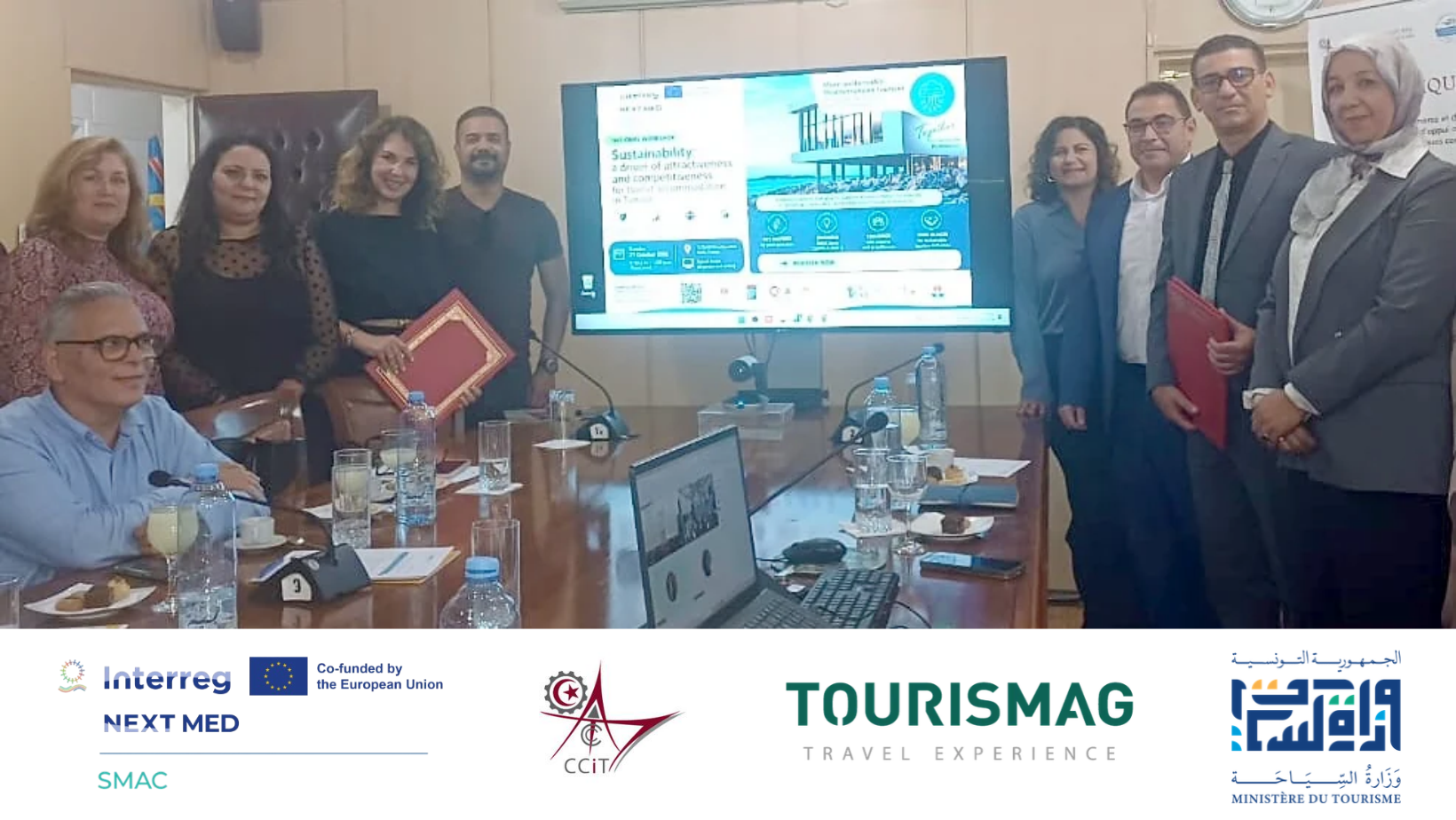
The workshop organised on 27 October 2026 by the Tunis Chamber of Commerce and Industry, in collaboration with the Ministry of Tourism and Handicrafts, brought this issue into the Tunisian context. With the event now over, the question is what the approach can change in the day-to-day running of a property.
The Mediterranean in three figures
Nearly 400 million international tourists welcomed each year: the scale highlighted by Plan Bleu in its June 2026 publication.
Around 70% of tourism flows concentrated in coastal areas, according to Plan Bleu’s thematic overview.
Regional warming approximately 20% faster than the global average, according to Plan Bleu and UNEP/MAP.
These figures help explain the case for joint action. Visitor numbers, coastal concentration and climate pressures make resource management central to the future of destinations.
Bringing the transition within reach of small businesses
For a small property, the difficulty often begins before the first investment. Which framework should it use? What data should it collect? Where should a manager start when they already handle bookings, purchasing and staff?
Large hotel groups can draw on specialist teams. Independent accommodation providers generally have to fit these responsibilities into their existing workload. Yet this difference in resources says little about their willingness to improve or their ties to the local community.
SMAC’s distinctive approach is to take that constraint as its starting point. It aims to make sustainability requirements understandable and usable at the scale of a small business. Simplification will only be worthwhile if it retains what matters: relevant priorities, clear responsibilities and verifiable progress.
There is also a competitive dimension. A property that takes action but cannot document its practices may struggle to explain them to guests and business partners. Support should help it manage its operations more effectively, then make its efforts easier to understand.
Turning sustainability data into business decisions
The approach rests on two complementary tools. The Simplified Sustainability Model for Accommodation, or SSMA, is intended to establish a baseline using criteria suited to the businesses concerned. It covers energy, water and waste alongside social and economic considerations.
AIRET, the AI Recommendation Tool, is designed to turn that assessment into prioritised actions. Democritus University of Thrace contributes scientific and digital expertise to the project. The aim is to guide each property towards improvements that match its profile, with information to help assess their costs and potential benefits.
Consider an illustrative example. High water consumption at a small hotel may prompt checks for leaks, inefficient fittings, laundry practices or irrigation needs before major works are considered. The assessment helps locate the problem; the action plan should help the owner decide what to do, in which order and with what resources.
The quality of the recommendations will depend on the information entered and how it is interpreted. A swimming pool, a restaurant serving non-resident customers or highly seasonal demand will affect a property’s needs. The mentor included in the process is there to help account for those circumstances and follow implementation.
Part of SMAC’s value will lie in its ability to turn a recommendation on a screen into a lasting working practice.
Measuring what actually changes
For accommodation providers, a few consistently monitored indicators can already improve decision-making. Total water consumption shows the demand placed on the resource. Dividing it by the number of guest nights helps track changes in use against the level of activity.
The distinction matters. A bill can fall because a hotel has fewer guests. It can also rise despite improved efficiency if occupancy increases or utility prices change. Tracking volumes, costs and activity together helps explain what is happening.
The same reasoning applies to energy. Weighing food waste over a representative period can reveal unsuitable portion sizes, excessive purchasing or inaccurate forecasts of the number of meals required. These examples show how sustainability can become part of everyday management.
The expected benefits are practical: less waste, better control over certain operating costs and more informed investment decisions. They will need to be demonstrated through comparable data collected over a sufficient period. At this stage, they should not be presented as savings already achieved by participating businesses.
Keeping more tourism value in local communities
Environmental performance is only part of the picture. Working conditions, staff training, accessibility and relationships with local communities also contribute to a property’s sustainability.
Buying from a local producer can support a nearby business while giving the guest experience a stronger sense of place. But it requires a reliable relationship that works for both the property and the supplier. The impact depends on continuity of orders, the quality of the collaboration and payment for the work involved.
This perspective connects with Sustainable Tunisia | Human First, the initiative led by Donia Hamouda, founder and Editor-in-Chief of Tourismag.com, who spoke at the workshop. Her approach links improvements in tourism practices to local producers, artisans, guides and entrepreneurs, with particular attention to women and young people.
The alignment with SMAC opens opportunities to engage businesses, share practices and communicate results. These opportunities should be distinguished from activities already under way: a shared direction does not mean that every proposed initiative has been launched.
Connecting institutions and businesses
The Tunis workshop brought together Mohamed Souhaib Hsini, Director General of CCITunis; Mouna Gliss, Director General of International Cooperation at the Ministry of Tourism and Handicrafts; Io Chatzivaryti, Project Manager at the Drama Chamber of Commerce and Industry; Naoufel Azizi, SMAC Coordinator in Tunisia and Head of Cooperation at CCITunis; and Donia Hamouda, representing Tourismag.com.
Their involvement reflects the different contributions required for the transition: public policy, project coordination, technical expertise, dialogue with businesses and knowledge sharing. For CCITunis, the consortium’s Tunisian partner, close relationships with businesses are essential to identifying needs and supporting participation.
The Mediterranean partnership brings together seven organisations in five countries: the Drama Chamber of Commerce and Industry in Greece, as lead partner; the Alexandria Chamber of Commerce and the Confederation of Egyptian European Business Associations, CEEBA, in Egypt; the Association of the Mediterranean Chambers of Commerce and Industry, ASCAME, based in Spain; Democritus University of Thrace in Greece; CCITunis in Tunisia; and Adana Metropolitan Municipality in Türkiye.
Six associated partners extend this cooperation: Tecnopolis PST in Italy, the Union of Dannieh Municipalities in Lebanon, Greening the Islands International in Malta, Al-Quds Open University in Palestine, Alentejo Science and Technology Park in Portugal, and the Chamber of Commerce and Industry of Serbia.
The intended beneficiaries extend beyond accommodation owners and managers. Employees, visitors and local communities are also concerned, alongside local authorities, professional organisations, researchers and the mentors who will support businesses. Cooperation becomes useful when one territory’s experience helps others progress while respecting their particular constraints.
Complementary expertise across the Mediterranean
SMAC’s Mediterranean dimension lies in how these organisations can work together. Chambers of commerce and business associations bring an understanding of accommodation providers’ needs. The university contributes to the design of the tools. A local authority helps connect the approach to conditions on the ground, while Mediterranean networks and associated partners support the exchange of knowledge. Together, these contributions should bring research, business support and public decision-making closer.
The value of this cooperation is the opportunity to test a common method in different settings. A water-monitoring or food-waste reduction practice tested in one country may be useful elsewhere, provided it is adapted to the equipment, costs and services available. Pilot properties should therefore help improve the tools by reporting what works and what remains difficult to apply.
For Tunisia, the partnership offers access to expertise and practical experience while giving local businesses the opportunity to contribute to a shared method. This reciprocity gives the project its Mediterranean relevance: solutions can circulate, and each territory can adapt them to its own conditions.
Putting the tools to work
The project documentation provides for 35 pilot implementations, including five in Tunisia, followed by individual support for a further 70 properties. It also includes mentor training and a platform for resources and experimentation. These figures describe the planned rollout; they are not a record of completed results.
The pilots will test the method under real operating conditions. Are the criteria understandable? Can the required information be collected without an excessive workload? Can businesses afford the recommended actions? Do teams maintain the new practices?
The answers should help refine the tools and inform business support measures. A difficulty shared by several properties may stem from internal organisation, but also from access to finance, waste collection or the services available in a destination. SMAC’s planned recommendations to policymakers can help bring these obstacles into view.
Measurable progress that lasts
SMAC should also be understood in terms of its place in a property’s wider sustainability journey. An assessment and an improvement plan can prepare a business for certification. They do not, on their own, constitute independent certification. Similarly, the recognition scheme envisaged within the project should be communicated with a clear explanation of its scope.
That distinction matters for communication. Describing an action, specifying its monitoring period and explaining its results gives readers more useful information than a general claim to be a “green” property.
During the workshop, Tourismag signed an agreement with CCITunis as SMAC’s institutional media partner in Tunisia. The cooperation covers communication of the project’s activities and results to tourism professionals. This relationship is disclosed here for transparency about the publication’s connection to the project it covers.
Beyond March 2028, continuity will become the central question. Who will support businesses, update the tools and sustain the exchange of experience? The SMAC network and the skills developed during the project will need to carry the work forward.
The real impact will be seen in an accommodation provider’s ability to understand its starting point, choose a feasible improvement and measure the effects. If this method becomes part of everyday practice in small businesses, SMAC will have helped bring the transition within reach of an essential part of the Mediterranean tourism economy.
ASCAME: project overview and partner list. https://www.ascame.org/fr/project/smac/
Chambre de Commerce et d'Industrie de Tunis (CCIT): https://ccitunis.org.tn/smac/
Plan Bleu: https://planbleu.org/en/page-theme/tourism/
Plan Bleu: Mediterranean Tourism Facing Climate Change, note publiée le 16 juin 2026. https://planbleu.org/en/publications/mediterranean-tourism-facing-climate-change-towards-a-redefinition-of-the-tourism-model/
PNUE/PAM: Climate change in the Mediterranean. https://www.unep.org/unepmap/node/20387