

With Sidi Bou Saïd added to the UNESCO World Heritage List in 2026, Tunisia now has ten recognised properties. From Carthage to Djerba and from Kairouan to Dougga, they offer a journey through almost three millennia of Mediterranean history. Yet this tenth inscription carries a distinctive resonance: it celebrates a living village shaped by spirituality, architecture and artistic inspiration.
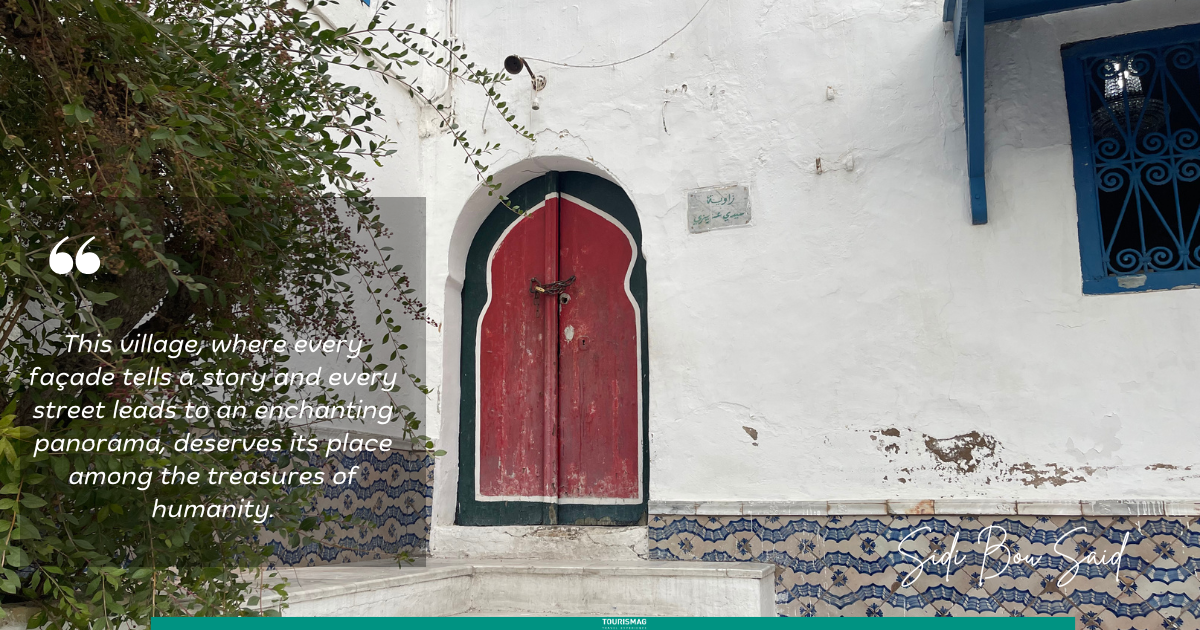
Perched above the Mediterranean, Sidi Bou Saïd has long been one of Tunisia’s most recognisable places. Its whitewashed houses, blue doors, shaded courtyards and sea-facing terraces have travelled around the world through photographs.
Its significance, however, extends far beyond its celebrated colour palette.
In 2026, Sidi Bou Saïd was officially inscribed on the UNESCO World Heritage List under criterion (iii), recognising its exceptional testimony to a cultural tradition. It becomes Tunisia’s tenth World Heritage property, following the inscription of Djerba in 2023.
UNESCO’s recognition draws attention to the village’s origins as a spiritual sanctuary developed around the mausoleum of the Sufi saint Abu Saïd Khalaf Ibn Yahya El Tamimi El Beji. Over the centuries, it evolved into a place of residence, retreat and cultural exchange, where local traditions encountered wider Mediterranean influences.
Tourismag previously explored the nomination and the qualities supporting Sidi Bou Saïd’s claim to Outstanding Universal Value. Read our earlier article on Sidi Bou Saïd’s UNESCO nomination.
Beyond the blue and white image
The UNESCO inscription celebrates an exceptional architectural identity, but it also encourages visitors to look more closely.
Sidi Bou Saïd is shaped by a delicate relationship between landscape, housing, spiritual landmarks, gardens and views across the Gulf of Tunis. Its streets, private residences and shared spaces reflect a distinctly Mediterranean way of inhabiting a place.
The village has also played an enduring role in Tunisia’s intellectual and artistic life. Painters, writers, musicians and travellers have found inspiration here, contributing to an identity that has never been confined to architecture alone.
Sidi Bou Saïd is not an open-air museum. It remains a lived-in village, and that is both its strength and its vulnerability.
World Heritage status brings international visibility, but it also carries a responsibility to preserve authenticity, manage urban development and address the pressures created by popularity. The next challenge will be to turn recognition into a model of sustainable cultural tourism that benefits residents, craftspeople, guides, artists and local businesses.
Ten sites, many faces of Tunisia
Tunisia’s World Heritage collection now comprises nine cultural properties and one natural site. Together, they reveal a country shaped by Punic, Roman, Amazigh, Islamic and Mediterranean histories.
1. Sidi Bou Saïd: a Mediterranean source of inspiration
Inscribed in 2026, Sidi Bou Saïd expresses the spiritual, residential and artistic dimensions of Tunisia’s heritage. Located close to the capital, it offers an evocative introduction to the country’s cultural landscape.
2. Archaeological Site of Carthage
Inscribed in 1979, Carthage remains one of the defining names of Mediterranean history. Its Punic remains, Roman baths and archaeological landscapes reveal the many layers of a city that once stood at the heart of the ancient world.
3. Medina of Tunis
Also listed in 1979, the Medina of Tunis contains an extraordinary concentration of mosques, madrasas, souks, palaces and traditional houses. It remains a living urban centre where heritage, craftsmanship and contemporary life continue to meet.
4. Amphitheatre of El Jem
The Amphitheatre of El Jem is among the most imposing Roman monuments in Africa. Its scale reflects the prosperity and influence of ancient Thysdrus during the Roman period.
5. Ichkeul National Park
Tunisia’s only natural World Heritage property, Ichkeul is a vital staging and wintering area for migratory birds. Its lake, wetlands and mountain form a rare ecosystem connecting Africa, Europe and the Mediterranean.
6. Punic Town of Kerkuane and its Necropolis
Located on the Cap Bon peninsula, Kerkuane offers an exceptional insight into Punic town planning. As it was not extensively rebuilt by later civilisations, the structure of the original settlement remains remarkably legible.
7. Kairouan
One of the great historic and spiritual cities of the Islamic world, Kairouan is home to its monumental Great Mosque, ancient water basins, souks and traditional medina. The city embodies more than twelve centuries of knowledge, faith and craftsmanship.
8. Medina of Sousse
Protected by walls overlooking the sea, the Medina of Sousse preserves an outstanding example of early Islamic coastal architecture. Its ribat, Great Mosque and kasbah recall the city’s strategic importance in the Mediterranean.
9. Dougga / Thugga
Set amid the landscapes of north-western Tunisia, Dougga is one of North Africa’s best-preserved ancient cities. Its theatre, Capitol, temples, baths and residential quarters create an archaeological ensemble of striking coherence.
10. Djerba: Testimony to a settlement pattern in an island territory
Inscribed in 2023, Djerba is recognised for a distinctive settlement system shaped by the island’s environment and resources. Its menzels, mosques, agricultural landscapes and pathways reflect the relationship between communities and territory over time.
A new gateway to Tunisia
These ten properties are more than a collection of monuments. Together, they tell the story of a plural Tunisia shaped by movement, faith, trade, creativity and the civilisations that have crossed the Mediterranean.
Sidi Bou Saïd can now become a natural gateway to that story. Its proximity to Carthage and the Medina of Tunis makes it possible to connect three UNESCO World Heritage properties within the wider Tunis area — an exceptional concentration for cultural travellers.
The opportunity extends far beyond the capital. From the north-west to Djerba and from Cap Bon to the Sahel, Tunisia’s UNESCO sites can anchor longer cultural routes, encourage visitors to explore beyond traditional tourism centres and bring greater value to local communities.
Sidi Bou Saïd’s inscription is therefore both a recognition and a beginning. It gives Tunisia a renewed opportunity to present its heritage internationally with greater coherence, quality and responsibility.
The village’s blue and white beauty may capture the eye. Its deeper story — and the wider story of Tunisia’s ten World Heritage properties — is what can now invite travellers to stay, explore and understand.
With the Medina of Tunis, the Archaeological Site of Carthage and now the Village of Sidi Bou Saïd, Greater Tunis alone brings together three UNESCO World Heritage properties. This exceptional concentration of cultural heritage further strengthens the destination’s appeal as Tunis prepares to become the Arab Tourism Capital in 2027.