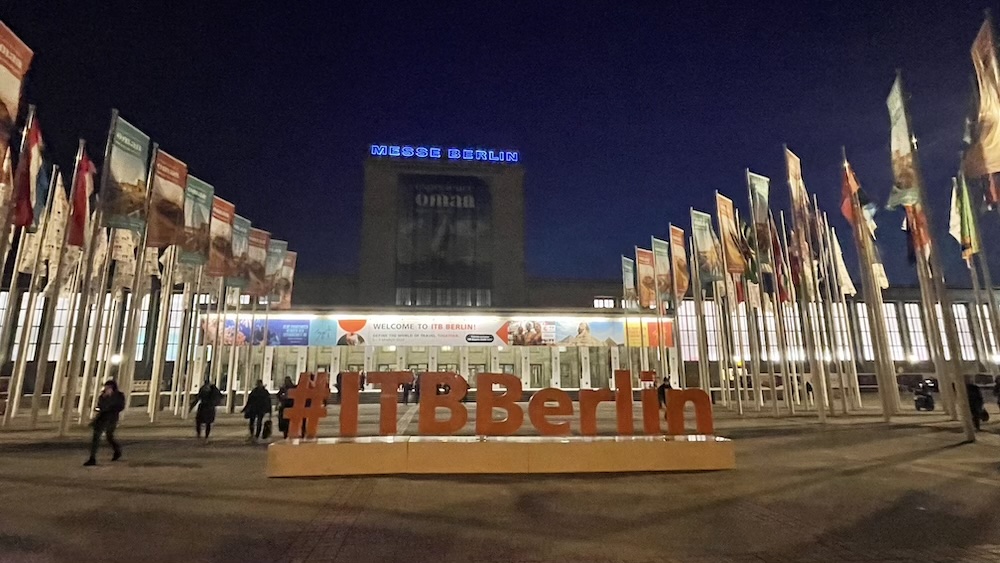

Presented during VivaTech 2026 in Paris, new research commissioned by Booking.com in partnership with Oxford Economics highlights the economic weight of travel demand across Europe, from accommodation and transport to retail, food services, entertainment and regional economies.
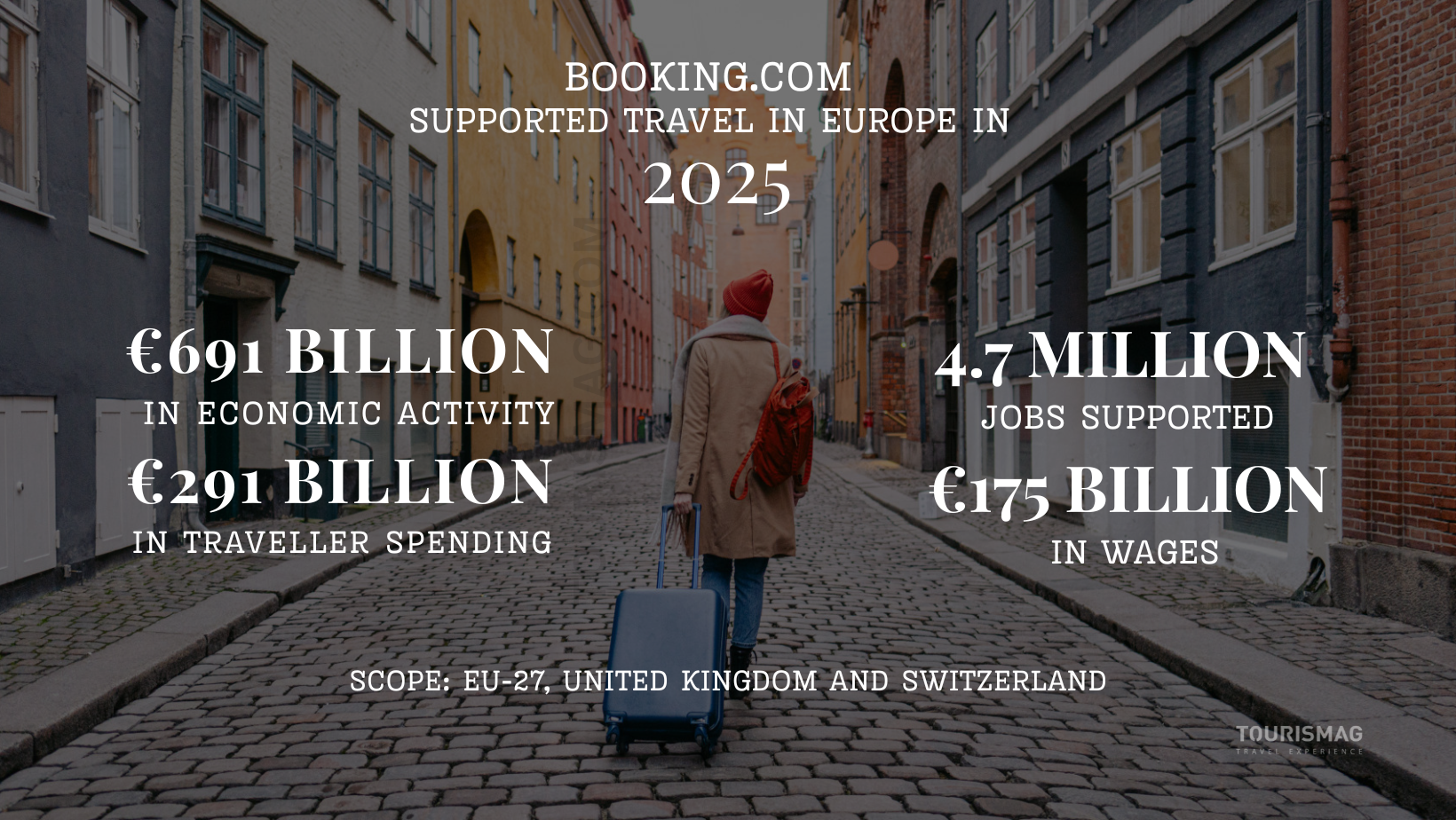
Travel reserved through Booking.com supported €691 billion in economic activity across Europe in 2025, according to new research commissioned by Booking.com in partnership with Oxford Economics.
The study, unveiled during VivaTech 2026 in Paris, covers the EU-27, the United Kingdom and Switzerland. It highlights the contribution of travel demand to jobs, wages and business activity across the continent.
According to the research, travellers using Booking.com spent €291 billion during their trips in Europe in 2025. This spending supported not only accommodation providers, but also businesses across hospitality, retail, transport and entertainment.
The activity linked to this travel demand supported 4.7 million jobs and €175 billion in wages across Europe.
Key figures from the study
The report also notes that the €691 billion figure is comparable to the GDP of Belgium, described in the release as the seventh largest economy in the European Union.
A broader impact beyond accommodation
The research underlines that the economic impact of travel extends well beyond hotel bookings. Visitor spending creates effects across several sectors, including food services, retail, transport, entertainment, local suppliers and wider supply chains.
According to the report, visitor spending linked to travel demand associated with Booking.com generated nearly €300 billion in additional economic activity across Europe.
This point was also highlighted by David Goodger, Managing Director EMEA of Oxford Economics, who said that Europe’s travel economy depends not only on major destinations, but also on the ability of smaller businesses and regional economies to access travel demand.
The impacts extend well beyond accommodation.
David Goodger, Managing Director EMEA, Oxford Economics
 The study highlights the ripple effects of travel spending across hospitality, retail, transport and entertainment. Photo TMG - Hotel Carlton Cannes
Technology and access to global demand
The study also points to the role of digital travel platforms in connecting businesses of different sizes to international demand.
Booking.com said the findings show how platforms can support independent accommodation providers and SMEs by helping them reach travellers from different markets.
Glenn Fogel, CEO of Booking.com, described travel as one of Europe’s major economic drivers and said that technology can help smaller businesses compete more effectively with larger players.
Europe has an extraordinary asset in tourism and we’re proud to back it.
Glenn Fogel, CEO of Booking.com

The report was launched at VivaTech 2026, where Booking.com’s participation formed part of a wider conversation on innovation, competitiveness and economic opportunity in Europe.
SMEs and regional economies
A key message of the research is the importance of smaller businesses and regional economies in Europe’s travel sector.
The study indicates that travel demand facilitated through Booking.com supports businesses beyond major destinations, including independent accommodation providers, SMEs and local service operators.
For regional economies, access to international travel demand remains an important part of tourism development. The research links this access to local economic growth, job creation and wider business activity.
 The report points to the role of digital platforms in connecting SMEs and regional businesses to global travel demand. - Photo
Tourism, jobs and economic growth
The figures presented by Booking.com and Oxford Economics underline the role of tourism as a major employer in Europe.
With 4.7 million jobs supported and €175 billion in wages, the report positions travel demand as a significant contributor to employment and household income across the region.
The study also refers to tax revenues and business activity generated through the travel economy, although the main figures highlighted in the release focus on economic activity, traveller spending, jobs and wages.
A VivaTech context
The launch of the report at VivaTech 2026 placed tourism within a broader innovation agenda. VivaTech’s 10th anniversary edition brought together technology companies, startups, investors, public institutions and business leaders in Paris.
For Booking.com, the study was presented as part of the discussion on how technology and innovation can support competitiveness and open new economic opportunities for European businesses and communities.
 At VivaTech 2026, Booking.com linked travel demand, technology and economic competitiveness in Europe.
The Booking.com and Oxford Economics study provides a quantified view of the economic activity associated with travel demand facilitated by the platform in Europe.
Its main findings are clear: in 2025, this activity supported hundreds of billions of euros in economic output, millions of jobs and significant wages across Europe.
It also confirms that the value of travel is not limited to accommodation. Tourism spending circulates through restaurants, shops, mobility providers, entertainment businesses, cultural activities and local supply chains.
For Europe’s tourism sector, the report offers a reminder of the scale of travel’s contribution to the economy — and of the growing role of digital platforms in connecting demand with businesses across destinations.
Headquartered in Amsterdam, European startup success story Booking.com's mission is to make it easier for everyone to experience the world. By investing in the technology that helps take the friction out of travel, Booking.com's marketplace seamlessly connects millions of travelers with accommodations of all sizes, flights, rental cars, airport taxis and memorable in-trip experiences every day. For more information, follow @bookingcom on social media or visit globalnews.booking.com.
About Oxford Economics
Oxford Economics is one of the world’s foremost independent global advisory firms. This study was conducted by the Tourism Economics group within Oxford Economics, which combines traveller dynamics with rigorous economics to assess the impact of travel and tourism.